AI Adoption and Its Influence on Cognitive Engagement and Critical Thinking Among University Students
DOI:
https://doi.org/10.54741/ASEJAR/5.2.2026.186Keywords:
AI-assisted learning, higher education, critical thinking, artificial intelligence, cognitive engagementAbstract
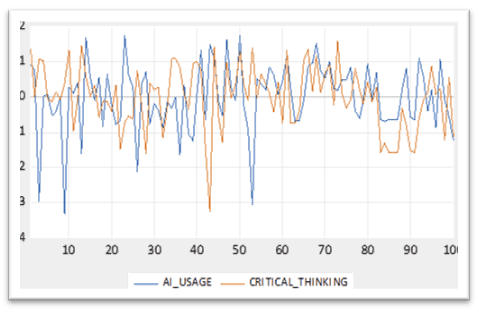
The swift adoption of artificial intelligence (AI) tools in higher education has greatly impacted the academic activities and study approaches of a large number of students, as well as their thinking styles. This research is concerned with the investigation of the extent of parties’ AI employment in multiple academic works, as well as exploring how patterns of AI use relate to the level of critical thinking. Based on primary data, the study makes use of a structured questionnaire to assess the frequency and purpose of AI-aided learning, as well as self-reported measures of critical thinking, among undergraduate and graduate students.
This descriptive - correlational study can reveal patterns of use, and it can explore potential relationships. Descriptive statistics, reliability tests and correlation analyses will be used to analyse the data to investigate the relationship between the degree of AI implementation in academic work and students’ cognitive engagement. The results will likely add substance to continuing conversations surrounding the potential educational fallout from AI and also offer actionable recommendations for educators attempting to right the scale between tech adoption and essential skills development.
Downloads
References
Chen, L., Chen, P., & Lin, Z. (2020). Artificial intelligence in education: A review. IEEE Access, 8, 75264–75278. https://doi.org/10.1109/ACCESS.2020.2988510
Davenport, T. H., & Ronanki, R. (2018). Artificial intelligence for the real world. Harvard Business Review, 96(1), 108–116.
Pokrivcakova, S. (2019). Preparing teachers for the application of AI-powered technologies in foreign language education. Journal of Language and Cultural Education, 7(3), 135–153. https://doi.org/10.2478/jolace-2019-0025
Velander, J., Taiye, M. A., Otero, N., & Milrad, M. (2024). Artificial intelligence in K–12 education: Eliciting and reflecting on Swedish teachers’ understanding of AI and its implications for teaching and learning. Education and Information Technologies, 29, 4085–4105. https://doi.org/10.1007/s10639-023-11990-4
Wang, T., Lund, B. D., Marengo, A., Pagano, A., Mannuru, N. R., Teel, Z. A., & Pange, J. (2023). Exploring the potential impact of artificial intelligence (AI) on international students in higher education: Generative AI, chatbots, analytics, and international student success. Applied Sciences, 13(11), 6716. https://doi.org/10.3390/app13116716
Yue, M., Jong, M. S. Y., & Ng, D. T. K. (2024). Understanding K–12 teachers’ technological pedagogical content knowledge readiness and attitudes toward artificial intelligence education. Education and Information Technologies, 29, 19505–19536. https://doi.org/10.1007/s10639-024-12621-2
Published
How to Cite
Issue
Section
License
Copyright (c) 2026 Shahbaaz Ahmed, Ishani Singha, Nandlal Pandey

This work is licensed under a Creative Commons Attribution 4.0 International License.
Research Articles in 'Applied Science and Engineering Journal for Advanced Research' are Open Access articles published under the Creative Commons CC BY License Creative Commons Attribution 4.0 International License http://creativecommons.org/licenses/by/4.0/. This license allows you to share – copy and redistribute the material in any medium or format. Adapt – remix, transform, and build upon the material for any purpose, even commercially.


