Evaluation of Zero Tillage Maize under Irrigated Conditions
DOI:
https://doi.org/10.54741/ASEJAR/5.2.2026.184Keywords:
zero tillage, maize cultivation, intercropping, land equivalent ratio, conservation agricultureAbstract
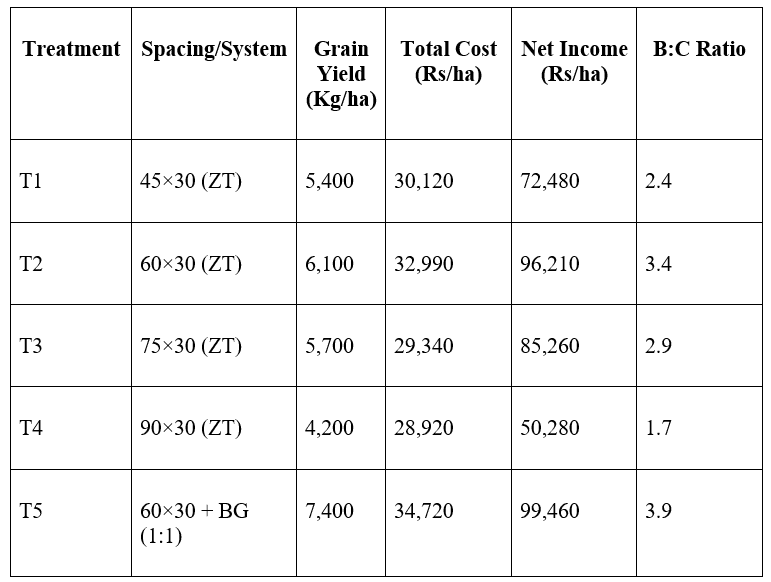
A field experiment was conducted at Krishna College of Agriculture and Technology during the period from June to August 2025 to assess the productivity and economic viability of zero tillage (ZT) maize cultivation in comparison with the conventional method of ridges and furrows. The study focused on evaluating different plant spacings ranging from 45×30 cm to 90×30 cm, along with the integration of black gram as an intercrop under a sustainable cropping system. The experimental design aimed to identify an optimal combination of spacing and intercropping that enhances yield, resource-use efficiency, and profitability.The results revealed that zero tillage maize planted at a spacing of 60×30 cm and intercropped with black gram in a 1:1 ratio significantly outperformed all other treatments. This combination recorded the highest grain yield of 7,400 kg/ha, indicating improved crop performance under reduced soil disturbance. Additionally, the Land Equivalent Ratio (LER) of 1.22 confirmed the advantage of intercropping over monocropping in terms of efficient land utilization. From an economic perspective, this treatment also generated the highest net income of ₹99,460 per hectare and achieved a Benefit-Cost (B:C) ratio of 3.9, which was notably higher than the conventional control treatment (3.3).The findings highlight that zero tillage combined with pulse-based intercropping not only enhances crop productivity but also improves soil health, reduces cultivation costs, and increases farm profitability. Therefore, the adoption of zero tillage maize intercropped with black gram can be considered a technically feasible, environmentally sustainable, and economically superior practice for conservation agriculture in Tamil Nadu. The study provides valuable insights for farmers, researchers, and policymakers aiming to promote sustainable intensification in maize-based cropping systems.
Downloads
References
Anaya A L, Ramos L, Cruz R, Hernández J G, & Nava V. (1987). Perspectives on allelopathy in Mexican traditional agrosystems: A case study in Tlaxcala. J. Chem. Ecol., 11, 2083–2101. doi:10.1007/BF01012873.
ABPSD. (2012). Agri-business promotion and statistics division. Ministry of Agricultural Development, Government of Nepal, Kathmandu, Nepal.
Adeniyan ON. (2014). Effect of different population densities and fertilizer rates on the performance of different maize varieties in two rain forest agro-ecosystem of south west Nigeria. Afr. J. Plant Sci., 8(8), 410-415.
Agamy RA, Mohamed GF, & Rady MM. (2012). Influence of the application of fertilizer type on growth, yield, anatomical structure and some chemical components of wheat (Triticum aestivum L.) grown in newly reclaimed soil. Australian Journal of Basic and Applied Sciences, 6(3), 561-570.
Aguilar, J Illsley, & Marielle, C. (2003). Los sistemas agrícolas de maíz y sus procesos técnicos. G Esteva H Barreto (Eds) Sin maíz no hay país Conaculta Mexico, pp. 170–175.
Alvarez, R, & Steinbach, H.S. (2009). A review of the effects of tillage systems on some soil physical properties, water content, nitrate availability and crop yield in the Argentine Pampas. Soil Till. Res., 104(2009), 1-15.
Amato G, Ruisi P, Frenda A.S, Miceli G.D, Saia S, Plaia A, & Giambalvo D. (2014). Long-term Tillage and crop sequence effects on wheat grain yield and quality. Agron. J., 105(2014), 1317-1327.
Anderson B, & White D G. (1987). Fungi associated with corn stalks in Illinois in 1982 and 1983. Plant Disease 71, 135–137.
Anderson, J. R., & J. B. Hardaker. (1979). Economic analysis in the design of new technologies for small farmers. Economics in the design of small farmer technology. (Valdes, A., Scobic, G. M. & Dillon, J. L. (Eds)). Ames, Iowa State University Press, pp. 11-26.
Ashwani KT, Dushyant ST, Rakesh KP, Adikant P, & Prafull K. (2015). Effect of different plant geometry and nitrogen levels in relation to growth characters, yield and economics on sweet corn (Zea mays saccharata L.) at Bastar plateau zone. International Quartz Journal of Life Science, 10(3), 1223-1226.
Published
How to Cite
Issue
Section
License
Copyright (c) 2026 Vetrivendhan E, Devaprasath K, Madhumitha J

This work is licensed under a Creative Commons Attribution 4.0 International License.
Research Articles in 'Applied Science and Engineering Journal for Advanced Research' are Open Access articles published under the Creative Commons CC BY License Creative Commons Attribution 4.0 International License http://creativecommons.org/licenses/by/4.0/. This license allows you to share – copy and redistribute the material in any medium or format. Adapt – remix, transform, and build upon the material for any purpose, even commercially.


