DevSecOps Scan Engine: A Containerized Security Orchestration Framework
DOI:
https://doi.org/10.54741/ASEJAR/5.2.2026.183Keywords:
DevSecOps, container isolation, CI/CD security, SAST, DAST, SCA, security automation, vulnerability orchestrationAbstract
The rapid evolution of modern software delivery practices has significantly shortened development cycles, enabling organizations to release updates at an unprecedented pace. However, this acceleration has also increased the exposure of applications to security vulnerabilities, particularly when traditional security validation is performed only at later stages of development.
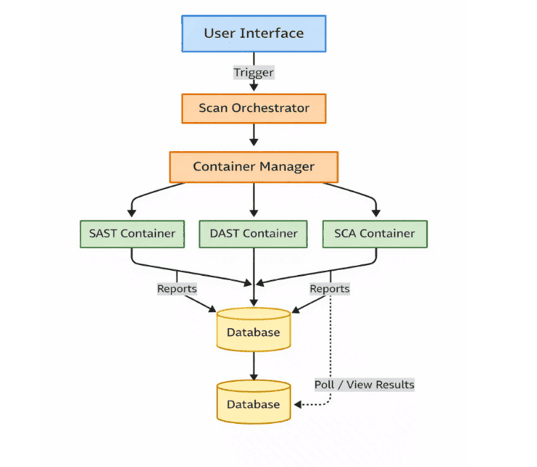
This paper presents the DevSecOps Scan Engine, a container-oriented orchestration framework designed to embed automated security analysis directly into continuous integration and continuous deployment workflows. The proposed system supports multiple categories of security testing, including static code analysis, dynamic application testing, and dependency vulnerability assessment, all executed within isolated and short-lived container environments. By leveraging containerization, the framework ensures consistency across executions while eliminating environmental dependencies and cross-process interference.
A standardized abstraction layer is introduced to unify the interaction between diverse security tools and pipeline components, transforming heterogeneous scanner outputs into a consistent structure for seamless integration with dashboards and automated decision-making systems.
Experimental evaluation demonstrates that the system supports concurrent scan execution with reliable isolation and efficient resource utilization, while effectively preventing deployments when critical vulnerabilities are detected. Overall, the proposed approach enables scalable and automated security validation while preserving the speed and flexibility required in modern development environments.
Downloads
References
A. Sharma, & M. Barenkamp. (2022). DevOps and DevSecOps: A systematic literature review. Journal of Software Engineering and Applications, 15(3), 123–145.
Ramprakash, P., Sakthivadivel, M., Krishnaraj, N., & Ramprasath, J. (2014). Host-based intrusion detection system using sequence of system calls. International Journal of Engineering and Management Research, 4(2), 241–247.
B. Fitzgerald, & K. Stol. (2017). Continuous software engineering: A roadmap and agenda. Journal of Systems and Software, 123, 176–189.
Saranya, N., Sakthivadivel, M., Karthikeyan, G., & Rajkumar, R. (2023). Securing the cloud: An empirical study on best practices for ensuring data privacy and protection. International Journal of Engineering and Management Research, 13(2), 46–49. https://doi.org/10.31033/ijemr.13.2.6
M. Beller, R. Bholanath, S. McIntosh, & A. Zaidman. (2016). Analyzing the state of static analysis: A large scale evaluation in open source software. Proc. IEEE SANER, pp. 1–10.
B. Johnson, Y. Song, E. Murphy Hill, & R. Bowdidge. (2013). Why developers avoid static analysis tools. Proc. Int. Conf. Software Engineering, pp. 672–681.
J. Fonsca, M. Vieira, & H. Madeira. (2007). Testing and comparing web vulnerability scanners for injection and cross site scripting attacks. Proc. Pacific Rim Int. Symp. Dependable Computing, pp. 365–372.
OWASP Foundation. (2021). OWASP Top 10: The ten most critical web application security risks.
D. Merkel. (2014). Docker: Lightweight Linux containers for consistent development and deployment. Linux Journal, 2014(239).
C. Pahl. (2015). Containerization and the platform as a service cloud. IEEE Cloud Computing, 2(3), 24–31.
L. Bass, I. Weber, & L. Zhu. (2015). DevOps: A software architect’s perspective. Boston, MA, USA: Addison-Wesley.
J. Wettinger, U. Breitenbücher, M. Falkenthal, F. Leymann, & M. Zimmermann. (2014). Integrating configuration management with model driven cloud management based on TOSCA. Proc. IEEE Int. Conf. Cloud Computing, pp. 437–444.
S. McConnell. (2004). Code complete. (2nd ed.). Redmond, WA, USA: Microsoft Press.
T. M. Chen, & S. Abu-Nimeh. (2001). Lessons from Stuxnet. Computer, 44(4), 91–93.
N. Antunes, & M. Vieira. (2009). Comparing the effectiveness of penetration testing and static code analysis on the detection of SQL injection vulnerabilities. Proc. IEEE ISSRE, pp. 301–306.
A. Sabahi. (2016). Secure containers in cloud computing: A survey. Proc. IEEE 8th Int. Conf. Cloud Computing Technology and Science, pp. 395–402.
R. Buyya, C. Vecchiola, & S. T. Selvi. (2013). Mastering cloud computing. New York, USA: McGraw Hill.
Published
How to Cite
Issue
Section
License
Copyright (c) 2026 S.Saravana Kumar, P. Vivekanandan, R. Dineshkumar, S. Sasitharan, N. Abinaya

This work is licensed under a Creative Commons Attribution 4.0 International License.
Research Articles in 'Applied Science and Engineering Journal for Advanced Research' are Open Access articles published under the Creative Commons CC BY License Creative Commons Attribution 4.0 International License http://creativecommons.org/licenses/by/4.0/. This license allows you to share – copy and redistribute the material in any medium or format. Adapt – remix, transform, and build upon the material for any purpose, even commercially.


