Infusing Generative AI into Supply Chain Management: Driving Intelligent and Anticipatory Operations
DOI:
https://doi.org/10.5281/zenodo.17227221Keywords:
generative AI, supply chain management, demand forecasting, inventory optimization, predictive analytics, intelligent operations, anticipatory decision-making, logistics efficiency, artificial intelligence in SCMAbstract
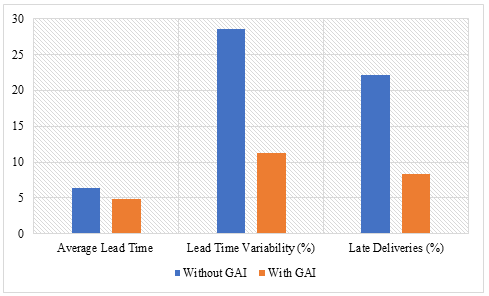
Because global supply chains are changing so quickly, businesses need to use new technologies to make them more flexible, accurate, and strong. This study looked into the possible use of Generative Artificial Intelligence (GAI) in supply chain management (SCM) to make operations smarter and more proactive. The study looked at GAI's effects on important supply chain tasks like demand forecasting, inventory optimization, supplier risk assessment, and logistics coordination using a mix of approaches, including simulation modeling and expert reviews. The results showed that GAI made forecasts much more accurate, sped up decision-making, improved inventory levels, and made lead time less variable. Experts agreed that GAI had a lot of technological potential, but they also stressed the importance of human control, interpretability, and ethical use. The results showed how GAI can change the way supply chain ecosystems work by making them more proactive and data-driven, which lets them adapt to changing market conditions.
Downloads
References
A. S. George. (2024). AI-enabled intelligent manufacturing: A path to increased productivity, quality, and insights. Partners Univ. Innov. Res. Publ., 2(4), 50–63.
A. Sharma. (2024). From blueprint to flight: Guiding your first generative AI project—revolutionizing service desk operations.
D. Brunner, C. Legat, & U. Seebacher. (2024). Towards next generation data-driven management: Leveraging predictive swarm intelligence to reason and predict market dynamics. in Collective Intelligence, CRC Press, pp. 152–203.
D. Brunner, C. Legat, & U. Seebacher. (2024). Towards next generation data-driven management: Collective intelligence—The rise of swarm systems and their impact on society. CRC Press, p. 152.
F. Dou et al. (2023). Towards artificial general intelligence (AGI) in the internet of things (IoT): Opportunities and challenges. arXiv:2309.07438.
F. Jia, S. Hu, Q. He, L. Chen, & X. Xing. The role of artificial intelligence in supply chain risk management: Towards an integrated conceptual framework. Available at: SSRN 4913631.
I. Jackson, D. Ivanov, A. Dolgui, & J. Namdar. (2024). Generative artificial intelligence in supply chain and operations management: a capability-based framework for analysis and implementation. Int. J. Prod. Res., 62(17), 6120–6145.
K. Hemachandran, D. Choudhury, R. V. Rodriguez, J. A. Wise, & T. Revathi. (2024). Predictive analytics and generative AI for data-driven marketing strategies. Boca Raton, FL, USA: CRC Press.
L. Luo. (2024). A web intelligent hotel management framework based on IoT and generative AI. J. Web Eng., 23(7), 885–912.
M. Kmiecik. (2023). ChatGPT in third-party logistics–The game-changer or a step into the unknown?, J. Open Innov. Technol. Mark. Complex., 9(4), 100174.
O. A. M. Mohamed. (2023). How generative AI transforming supply chain operations and efficiency?.
R. L. Julie, S. Raja, P. T. Selvan, M. R. Priya, & N. K. Rajagopal. (2024). Exploring the transformative effects of AI on entrepreneurship in business performance. in Balancing Automation and Human Interaction in Modern Marketing, IGI Global, pp. 127–150.
V. Kumar, & P. Kotler. (2024). A market management approach to transformative business operations. Mark. Strategy J., 1, 100005.
V. Yandrapalli. (2023). Revolutionizing supply chains using power of generative AI. Int. J. Res. Publ. Rev., 4(12), 1556–1562.
W. Lo, C. M. Yang, Q. Zhang, & M. Li. (2024). Increased productivity and reduced waste with robotic process automation and generative AI-powered IoE services. J. Web Eng., 23(1), 53–87.
Published
How to Cite
Issue
Section
License
Copyright (c) 2025 Vijayendra Vittal Rao

This work is licensed under a Creative Commons Attribution 4.0 International License.
Research Articles in 'Applied Science and Engineering Journal for Advanced Research' are Open Access articles published under the Creative Commons CC BY License Creative Commons Attribution 4.0 International License http://creativecommons.org/licenses/by/4.0/. This license allows you to share – copy and redistribute the material in any medium or format. Adapt – remix, transform, and build upon the material for any purpose, even commercially.


