Optimizing Real-Time Telemetry and Diagnostics with Azure SignalR and Redis Cache Integration
DOI:
https://doi.org/10.5281/zenodo.17226156Keywords:
azure signalr, redis cache, real-time telemetry, diagnostics, cloud computing, scalability, low latency, IoTAbstract
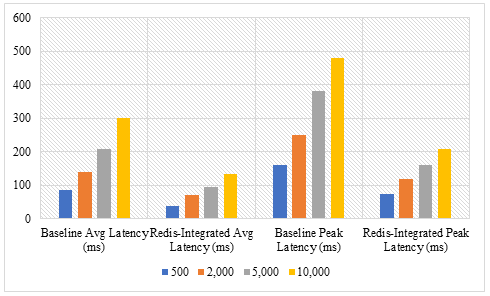
This study looked into how to integrate Azure SignalR and Redis Cache to optimize real-time telemetry and diagnostics. A basic system without Redis integration was contrasted with a prototype system that integrated Redis with Azure SignalR. Metrics such as latency, throughput, scalability, error rates, and cache effectiveness were used to assess performance using simulated telemetry data streams under various client loads. The findings showed that Redis integration enhanced throughput by about 60%, decreased average and peak latency by over 50%, and preserved system stability with up to 10,000 concurrent clients. Redis' dependability for handling frequent queries was confirmed by cache hit ratios that continuously above 90%. The results demonstrated that integrating Redis Cache with Azure SignalR offered a fault-tolerant, low-latency, and scalable solution for real-time telemetry settings. For crucial fields like industrial monitoring, medical diagnostics, and Internet of Things applications needing effective large-scale data processing, this strategy provided significant benefits.
Downloads
References
F. Zhang. (2025). Distributed cloud computing infrastructure management. International Journal of Internet and Distributed Systems, 7(3), 35–60.
R. Ajayi. (2025). Integrating IoT and cloud computing for continuous process optimization in real-time systems. Int. J. Res. Publ. Rev., 6(1), 2540–2558.
P. S. Kiran, B. T. Reddy, V. K. Reddy, & K. T. Rao. (2025). Effective cloud infrastructure for optimal telehealth service. in Role of Artificial Intelligence, Telehealth, and Telemedicine in Medical Virology, Singapore: Springer Nature Singapore, pp. 97–128.
R. P. M. Miranda. (2024). Real-time information processing.
R. P. M. Miranda. (2024). Real-time information processing. Ph.D. Dissertation, Univ. do Minho, Portugal.
M. D. H. da Silva Bravo. (2021). Migration of a client-server application to a cloud architecture.
V. D. P. N. Kwizera, Z. Li, V. E. Lumorvie, F. Nambajemariya, & X. Niu. (2021). IoT based greenhouse real-time data acquisition and visualization through message queuing telemetry transfer (MQTT) protocol. Advances in Internet of Things, 11(2), 77–93.
A. Cavani, L. Melo, V. Vivas, & D. Gomes. (2025). Comprehensive review of real-time electric and hybrid fiber/electric telemetry in CT interventions. in SPE/ICoTA Well Intervention Conf. and Exhibition, p. D021S006R003.
K. M. Fakolujo, H. Mamman, A. Sobowale, & R. Arab. (2023). Maximizing reservoir contact using memory quality LWD logs in real-time from high-bandwidth wired drill pipe telemetry technology. in SPE Annu. Tech. Conf. and Exhibition, p. D011S008R001.
A. B. Al-Arnous, Z. Al-Bensad, D. Ahmed, M. N. Bin Md Noor, N. Batita, & A. M. Khan. (2021). Successful intervention of coiled tubing rugged tool with real-time telemetry system in Saudi Arabia first multistage fracturing completion with sand control system. in SPE Annu. Tech. Conf. and Exhibition, p. D031S043R005.
A. N. Rutenko, M. M. Zykov, V. A. Gritsenko, M. Y. Fershalov, M. R. Jenkerson, R. Racca, & V. E. Nechayuk. (2022). Real-time acoustic monitoring with telemetry to mitigate potential effects of seismic survey sounds on marine mammals: a case study offshore Sakhalin Island. Environmental Monitoring and Assessment, 194(1), 745.
D. Y. Kim, Y. H. Ro, C. H. Hwang, & S. Y. Im. (2025). Optimizing real-time graphs of real-time data processing program for telemetry. J. Adv. Navigation Technol., 29(3), 317–323.
N. R. S. Muda. (2024). Telemetry system coding application on combat robots using firebase connection to spreadsheets. IJNRSM, 4(5), 170–178.
J. Logeshwaran, A. S. Pothukuchi, & V. Mallikarjunaradhya. (2023). Implementation of cloud computing and monte carlo simulation in the healthcare telemetry applications. in 6th Int. Conf. Contemporary Computing and Informatics (IC3I), 6, pp. 2242–2247.
S. Cuéllar, M. Santos, F. Alonso, E. Fabregas, & G. Farias. (2024). Explainable anomaly detection in spacecraft telemetry. Engineering Applications of Artificial Intelligence, 133, p. 108083.
Published
How to Cite
Issue
Section
License
Copyright (c) 2025 Anup Rao

This work is licensed under a Creative Commons Attribution 4.0 International License.
Research Articles in 'Applied Science and Engineering Journal for Advanced Research' are Open Access articles published under the Creative Commons CC BY License Creative Commons Attribution 4.0 International License http://creativecommons.org/licenses/by/4.0/. This license allows you to share – copy and redistribute the material in any medium or format. Adapt – remix, transform, and build upon the material for any purpose, even commercially.


